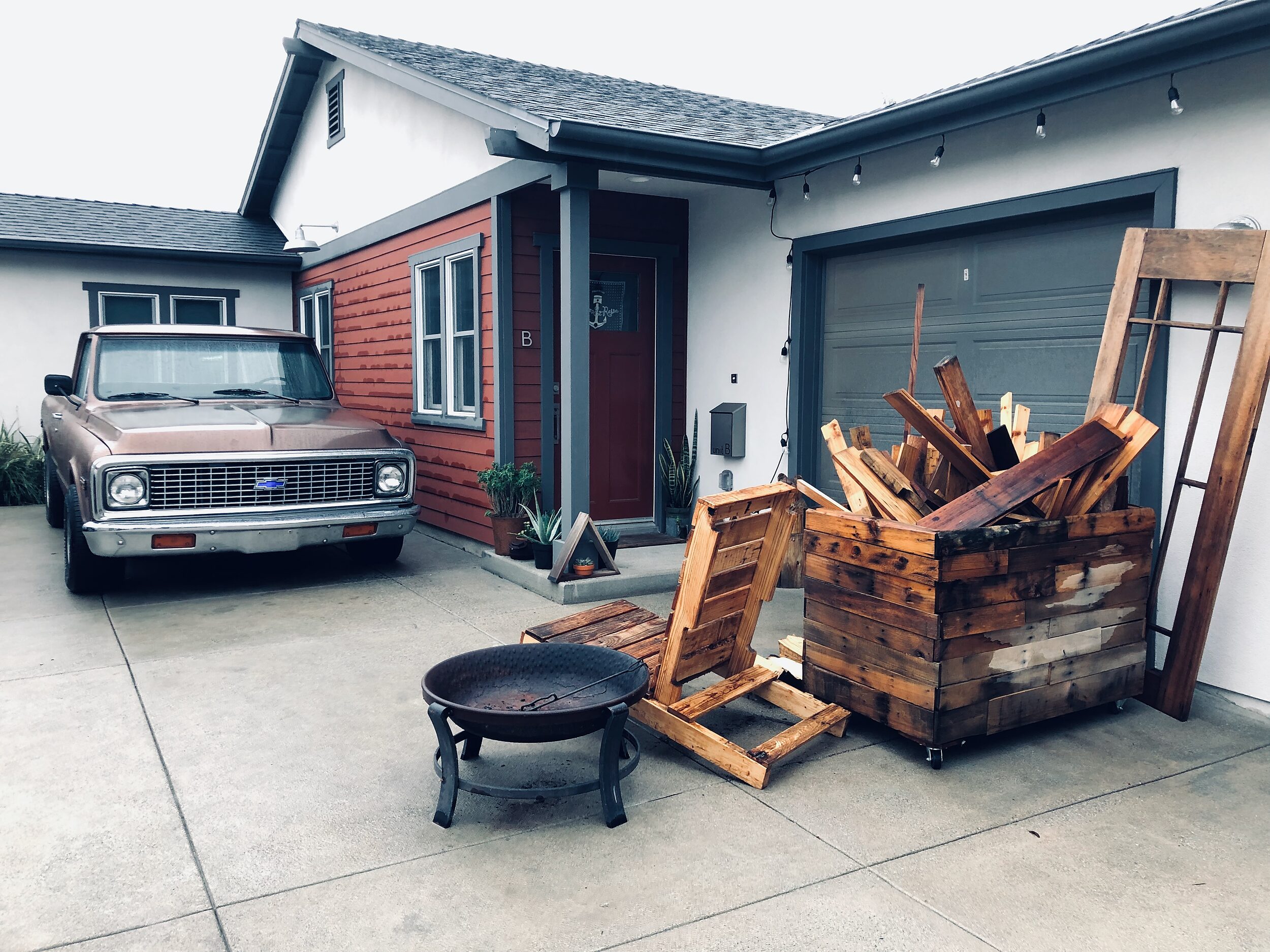
Every shop ends up with a pile of offcuts too good to throw away and too awkward to store, short lengths of trim, cut-down boards, the odd curved or notched scrap. This build turns that pile into something useful: a rolling bin, framed in new lumber and clad entirely in reclaimed pallet boards, that rolls wherever the mess needs corralling.

Overview
The bin is a simple open-top box, tall enough to stand scrap boards upright inside rather than stacking them flat, and it rolls on a set of casters so it can be pushed out of the way or wheeled over to wherever cutoffs are piling up. The construction is a two-material approach: a frame built from new, unfinished dimensional lumber, clad on the outside in horizontal courses of reclaimed pallet boards. The contrast between the light, clean frame lumber at the corners and top rail and the weathered, mixed-tone reclaimed boards on the walls is a big part of what makes the finished piece look intentional rather than scrappy.
Materials
- New dimensional lumber, used for the box’s structural frame (top rail, corner posts, and an intermediate brace across the taller sides).
- Reclaimed pallet boards, fastened horizontally over the frame as cladding on all sides, in mixed widths and finishes/tones (some darker/weathered, some lighter), which gives the exterior its patchwork look.
- Casters, four wheels mounted to the base so the finished bin rolls.
Tools
Tools: a pneumatic finish nail gun (with hose, used to fasten the cladding boards), bar/pipe clamps, a hammer, and a flathead screwdriver.
Design Details
Frame first, then clad. Rather than building solid panel sides, the bin starts as an open box frame. You can see the bare frame with casters already attached before any cladding goes on. The reclaimed boards are then fastened directly to that frame, one horizontal course at a time, working up from the base.
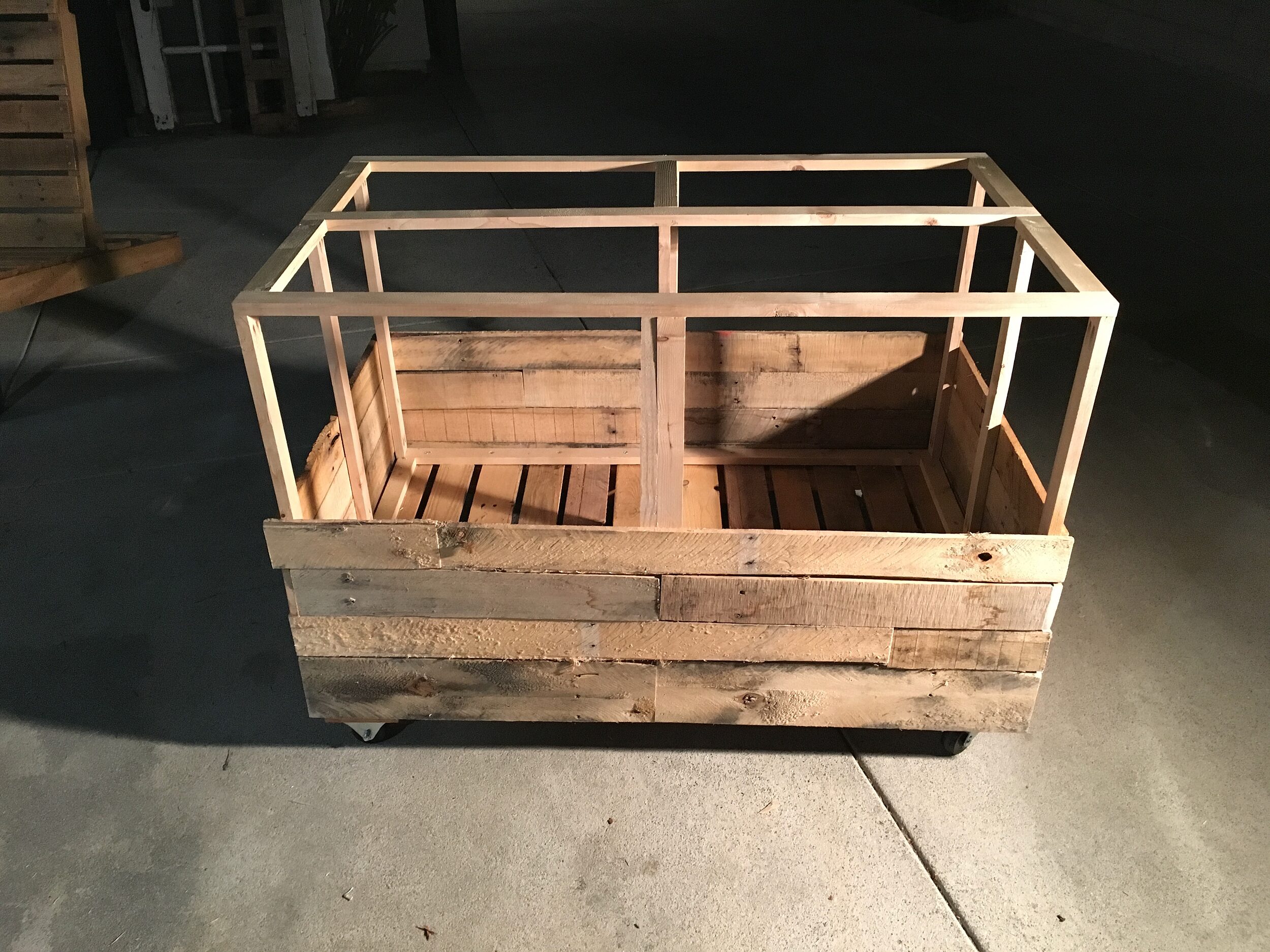
Patchwork cladding from mismatched boards. The reclaimed pallet boards vary in width, tone, and wear from board to board (some are pale and clean, others darker and weathered), and rather than sorting for a uniform look, the build leans into the mix. The result reads as a deliberate patchwork pattern rather than mismatched scraps.
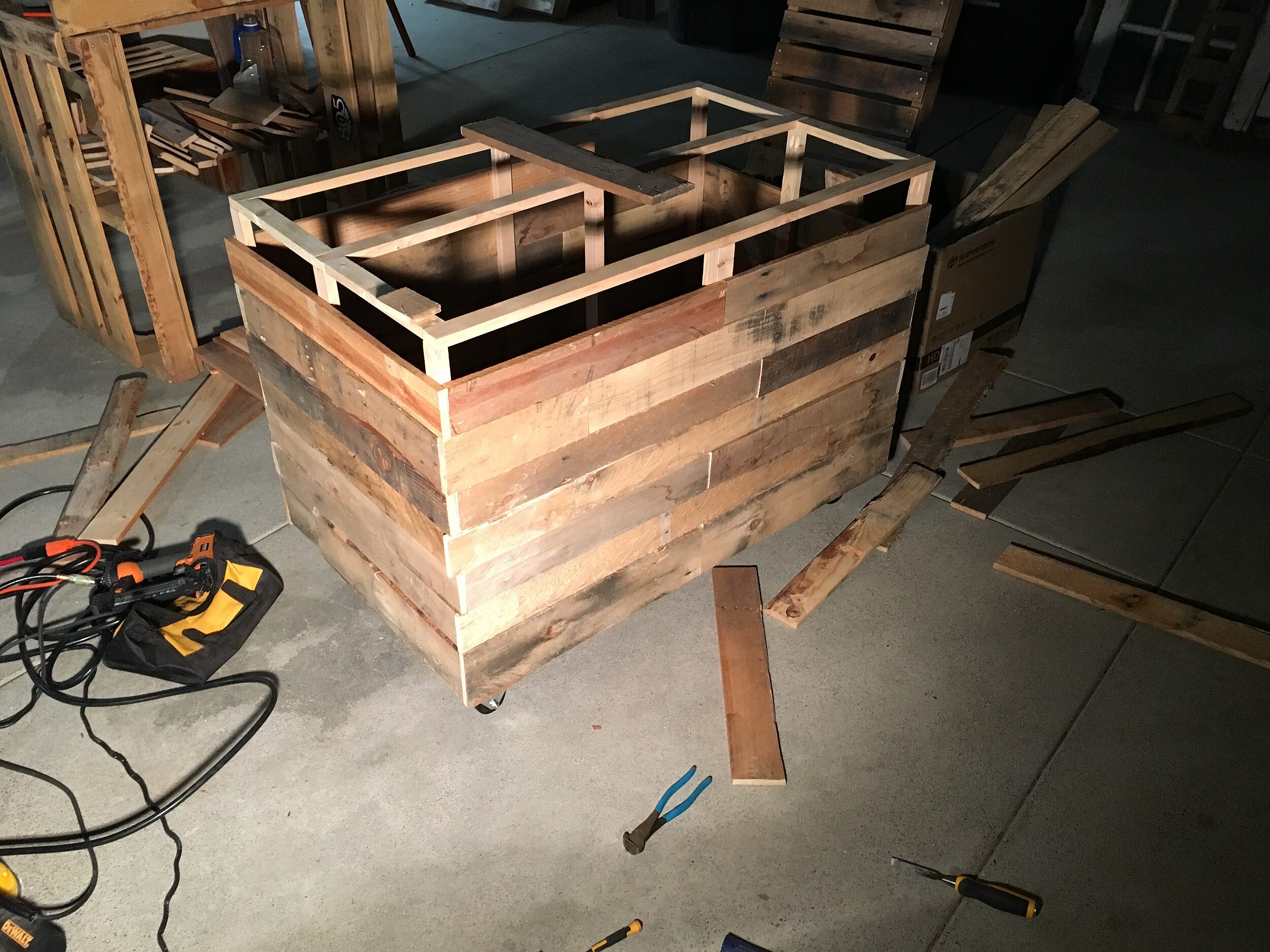
Build Process
Framing. The box frame (top rail, corner posts, and a mid-height brace on the longer sides) went together first, with the caster wheels mounted to the base early, before any cladding was added.
Cladding. Reclaimed pallet boards were then face-nailed to the frame in horizontal courses, working from the bottom up, on all four sides.
Finishing up. The bin is fully clad on all sides and already in use, standing scrap boards and offcuts upright inside.
The Finished Bin
Once finished, the bin went straight to work. It’s usually full of vertical offcuts, parked in the driveway alongside other reclaimed-wood shop pieces (a pallet-wood chair and a fire pit built from similar materials).